
Nioh 3 Best Samurai Weapons: Top Picks for Every Samurai Build
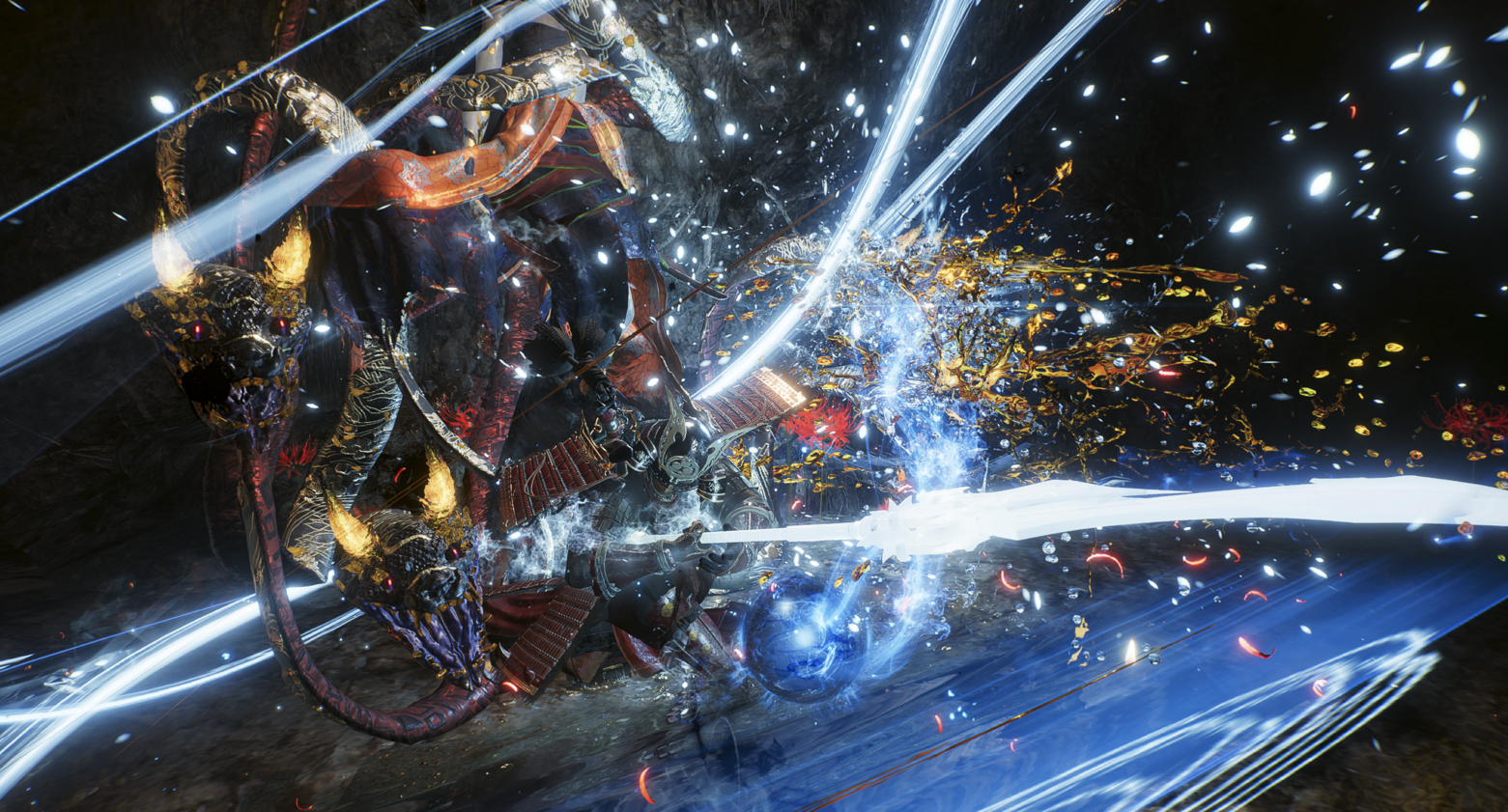
This guide ranks all seven Samurai weapons, breaks down what each one actually rewards in combat, identifies the best Martial Arts for each, and matches each weapon to the build identity where it performs best. If you're deciding which Samurai weapon to commit to — or you've been struggling with your current pick and want to know why — this is the reference you need.

The Samurai style in Nioh 3 is built around three-stance mastery, Ki Pulse timing, and finding the right moment to unleash punishing combos after reading an enemy's openings. Seven weapon types serve that philosophy — and each one does it differently. The Switchglaive rewards relentless stance-morphing aggression. The Spear wins through safe reach and spacing. The Axe hits harder than almost anything else in the game at the cost of speed and recovery. None of them are bad. All of them can clear Dream of the Nioh. But they are not equally suited to every playstyle, and picking the wrong one for how you naturally play creates friction that no amount of respeccing fixes.
This guide ranks all seven Samurai weapons, breaks down what each one actually rewards in combat, identifies the best Martial Arts for each, and matches each weapon to the build identity where it performs best. If you're deciding which Samurai weapon to commit to — or you've been struggling with your current pick and want to know why — this is the reference you need.
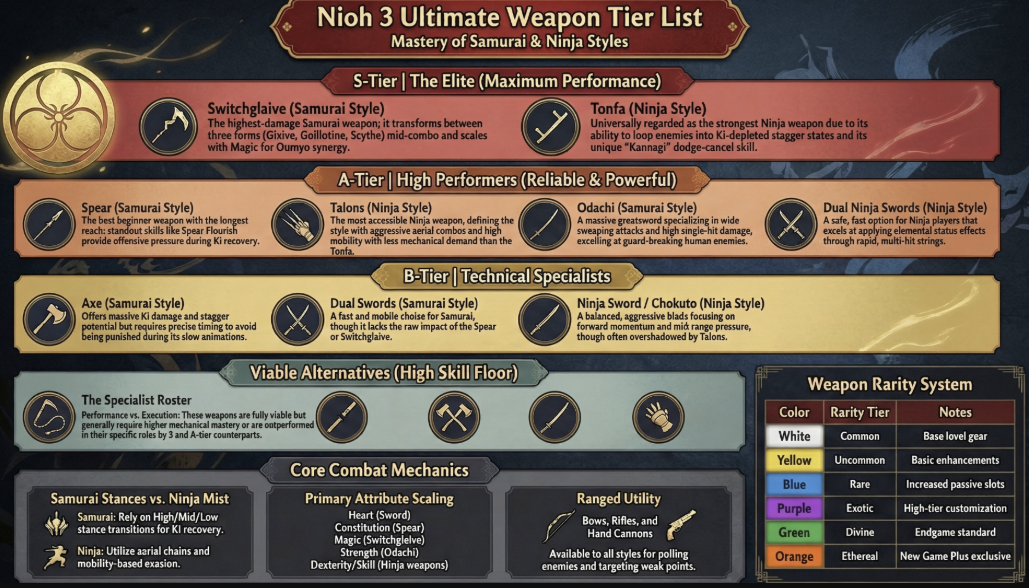
For a full cross-style ranking of all 14 weapons including Ninja options, see our Nioh 3 Best Weapons Tier List. For the stat investment logic behind each weapon, our Nioh 3 Weapons Scaling Guide covers every Reference Stat combination in detail.
Nioh 3 Samurai Weapons Tier Overview
| Tier | Weapon | Primary Stats | Playstyle Identity | Difficulty |
|---|---|---|---|---|
| S | Switchglaive | Intellect / Magic / Skill | Stance-morphing aggressor, Onmyo hybrid | Hard |
| S | Spear | Constitution / Skill / Heart | Safe range, hit-and-run, beginner-friendly | Easy |
| A | Odachi | Strength / Stamina / Magic | Sweeping crowd control, burst punisher | Medium |
| A | Axe | Strength / Stamina / Constitution | Maximum damage-per-swing, stance breaker | Medium-Hard |
| A | Dual Swords | Heart / Strength / Skill | Fast combos, deflect counterplay, Ki pressure | Medium |
| B | Sword | Heart / Strength / Intellect | Balanced fundamentals, learning weapon | Easy |
| B | Cestus | Strength / Constitution / Skill | Close-range Ki destruction, grapple pressure | Hard |
One important caveat before the rankings: the meta shift between S and B here is narrower than it looks on paper. What separates the Switchglaive and Spear from the Sword and Cestus isn't that the top weapons are dramatically more powerful — it's that they have fewer matchup problems and perform consistently well against a wider range of enemy types and encounters. A skilled Axe player will beat a mediocre Switchglaive player. The rankings reflect ceiling and consistency at equivalent player skill, not absolute verdict on viability.
S-Tier Samurai Weapons
Switchglaive — Best Samurai Weapon Overall
The Switchglaive is the highest-ceiling Samurai weapon in Nioh 3 and the one the game's entire design philosophy seems written around. It transforms between three physical forms based on your active stance: a glaive in High Stance (long-range sweeps), a guillotine blade in Mid Stance (wide horizontal arcs), and a scythe in Low Stance (rapid chained slashes). Switching stances mid-combo doesn't just change which form you're using — it generates a Ki Pulse recovery window via Flux II, meaning every stance transition is simultaneously an attack and a Ki refund. Execute the loop correctly and you never run out of Ki while staying permanently in offense.
That is the Switchglaive's value proposition: it's the only Samurai weapon where the mechanical act of dealing damage is the same mechanical act as recovering your stamina. Every other weapon requires you to pause attacks to Ki Pulse. The Switchglaive turns Ki management into a byproduct of correct play rather than an interruption to it.
The caveat is equally clear: if you're not stance-switching mid-combo, the Switchglaive performs like a below-average Samurai weapon. Its per-hit damage in any single form is unremarkable. The damage comes from the stance-morph chains, not from pressing the attack button in one stance repeatedly. Players who don't engage with the three-stance system deeply will consistently underperform with it. This is why it has the highest difficulty rating among Samurai weapons — not because the basics are hard to learn, but because extracting its actual ceiling requires mastery of a system the other weapons merely encourage.
The Switchglaive also has the deepest endgame build path of any Samurai weapon. Its Reference Stats (Intellect, Magic, Skill) feed directly into Onmyo Magic integration — higher Magic opens more Yin slot Talisman access, and the Grace of Tsukuyomi endgame set regenerates spell uses on kills, creating near-infinite elemental damage uptime in long fights. The Confusion loop build (applying Fire and Lightning simultaneously for massively increased damage taken) is the strongest single-weapon damage build in the game, and it lives on the Switchglaive.
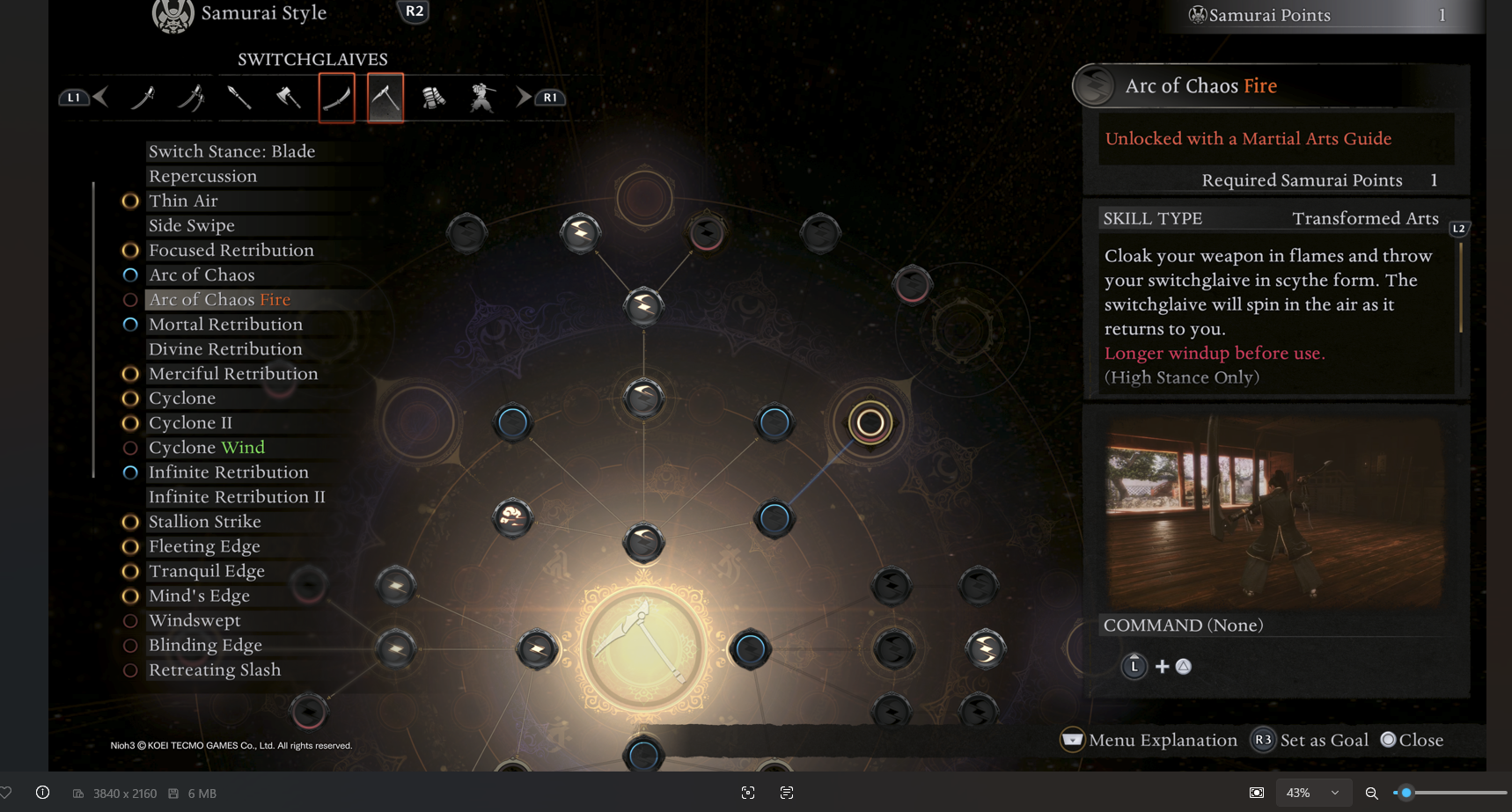
Best Martial Arts:
- Cyclone Wind — Spinning multi-hit attack that connects stance transitions. The core of every combo loop. Learn this first.
- Kibosh Kicker — Close-range combo extender for sustained pressure after landing an opening. Essential for keeping momentum going.
- Stallion Strike — Advancing aerial strike that maintains pressure while repositioning. Keeps you on top of fast-moving enemies.
- Arc of Chaos Fire — Throws the Switchglaive like a boomerang for mid-range Fire damage. Covers the gap between close-range combo range and enemy backing away. Use when you need safer reach without giving up aggression.
- Infinite Retribution II — Spinning finisher that chains multiple rotations into a high-damage conclusion. Pairs with Cyclone Wind as a combo cap.
Priority Skills: Flux II (Ki Pulse on stance switch — mandatory, unlock immediately), Running Water (dodge into Ki Pulse for evasive recovery), Deflect (parry for counter-attack setups), Oppressive Strength (prevents stagger during Arts Proficiency, keeps combos going under pressure).
Best for: Players who finished Nioh 1 or 2 and understand stance switching already. Players who want the highest late-game damage ceiling. Onmyo Magic hybrid builds. Anyone comfortable spending their first 10 hours learning a weapon before it starts paying off.
Avoid if: You're new to Nioh and want to learn the game's fundamentals before tackling an execution-demanding weapon. The Spear is the better choice to start.
Spear — Best Samurai Weapon for Consistency & Beginners
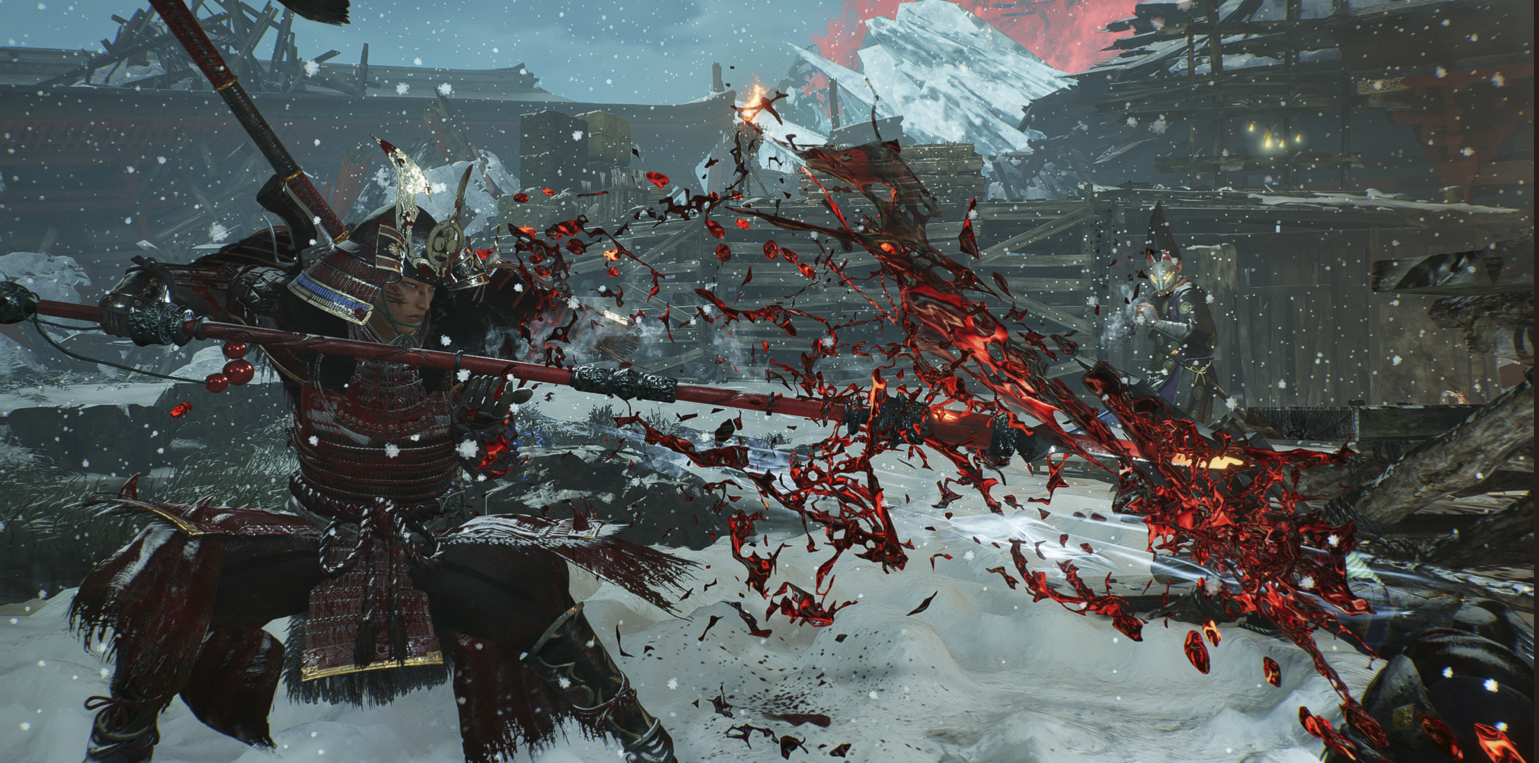
The Spear is the rare weapon that earns S-tier not through a mechanical ceiling that requires mastery to reach, but through consistent high performance that never requires you to execute anything complicated to get results. Its combos are simple two-hit chains that deal good damage, its range advantage over every other Samurai weapon naturally creates safe positions in most enemy matchups, and its Constitution primary scaling means you're building survivability and damage from the same stat investment.
What makes the Spear stand out mechanically in Nioh 3 specifically is how the hit-and-run playstyle it encourages aligns with the game's Samurai combat loop. The Spear's range means you're almost always poking enemies before they can reach you, which teaches pattern recognition organically — you're never forced into panicked close-range trading because you have the reach advantage by default. When you do take damage, your Constitution investment gives you a larger HP pool than virtually any Strength-primary build would have. The Spear is designed to produce good outcomes from correct spacing decisions, not from executing complicated combo strings.
In the endgame, the Spear's value shifts from being forgiving to being genuinely efficient. Its Constitution + Skill Reference Stats create the best cross-style pairing in the game when combined with the Tonfa on the Ninja side — every level-up benefits both weapons simultaneously, and the Spear/Tonfa combination covers the full range of combat situations: Spear for safe ranged pressure in Samurai style, Tonfa for devastating Ki-destruction close-range pressure in Ninja style. The Spear is also the entry point for the Water Spear build, one of the best boss-farming setups in the game, applying the Saturation debuff through Water elemental imbuement while staying at safe range.
Best Martial Arts:
- Fatal Thrust — Forward-charging thrust with high damage and stagger value. The go-to punish after reading an enemy opening.
- Spear Shove — Quick Ki-damaging poke that fits naturally between standard attack chains. Builds toward Winded state efficiently.
- Twisting Spear — Aerial combo option that deals damage while keeping you mobile. Extends the Spear's reach advantage into vertical space against large Yokai.
- Poke and Provoke — Rapid back-to-back thrusts that maintain distance while dealing consistent damage. Ideal against enemies whose attack windows are short.
Priority Skills: Deflect (even on a ranged weapon, parry opportunities matter for Ki generation), Arts Proficiency bonuses from the Samurai skill tree (the Spear's Martial Arts benefit heavily from Arts uptime), and medium armor proficiency skills to maximize mobility without sacrificing defense.
Best for: New players learning the game. Players who want a reliable weapon through all difficulty tiers without needing to re-learn their playstyle. The Spear + Tonfa cross-style pairing. Anyone who values consistent performance over mechanical ceiling.
Avoid if: You want heavy burst damage and are comfortable with slower, more deliberate swing timing. The Odachi or Axe will feel more satisfying.
A-Tier Samurai Weapons
Odachi — Best Samurai Weapon for Heavy Damage & Crowd Control
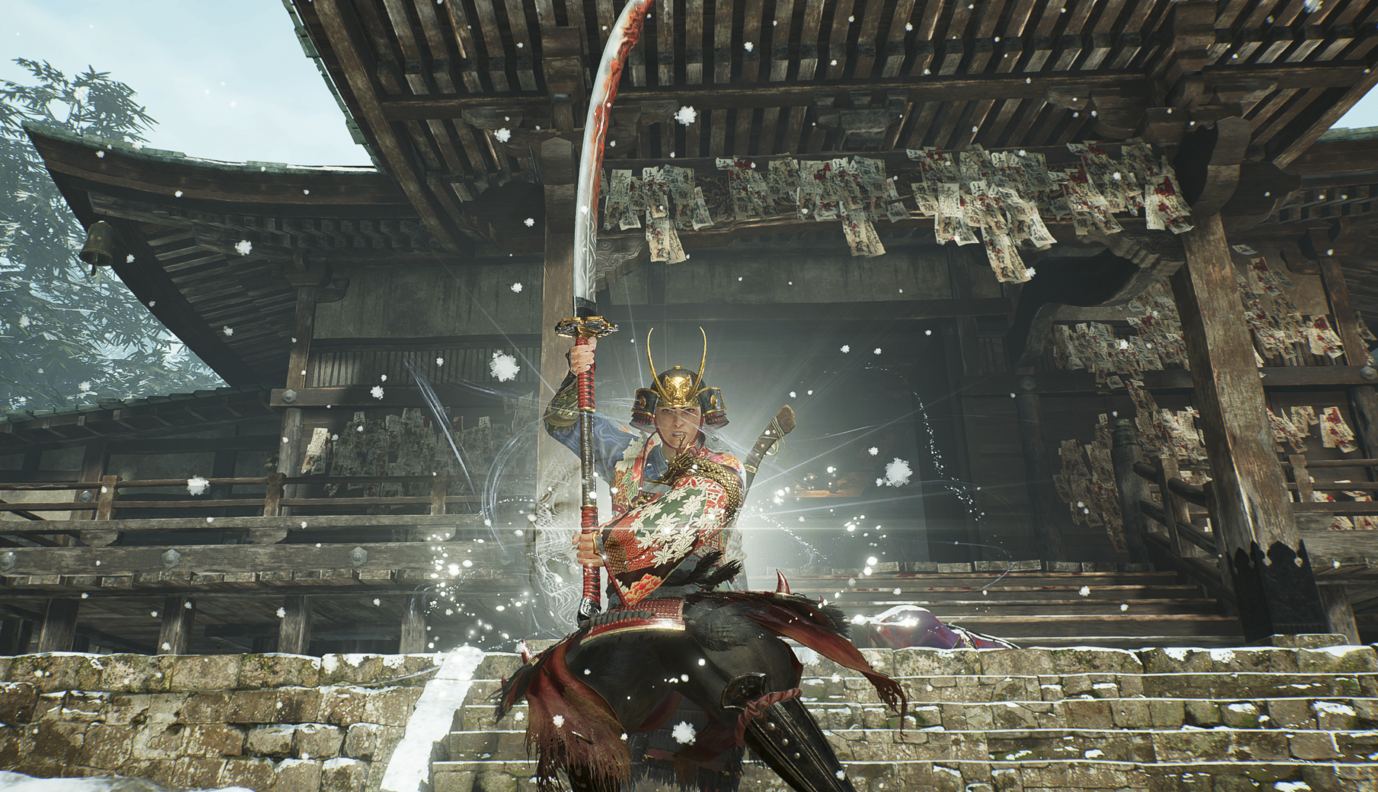
The Odachi is consistently cited alongside the Switchglaive as one of the two strongest Samurai weapons in the game — some tier lists place it in S alongside the Spear, others land it solidly at A. The distinction comes down to what you're optimizing for. The Odachi has the highest damage-per-swing ceiling of any Samurai weapon: its sweeping arc attacks deal massive single-hit damage, the wide arc hits multiple enemies simultaneously, and charged High Stance attacks can take meaningful percentages off boss health bars in a single window.
What places it at A rather than S is the Ki cost. Odachi attacks are heavy — each swing costs more Ki than equivalent attacks from faster weapons, and the Odachi's natural playstyle involves waiting for punish windows rather than maintaining constant pressure. If you miss a charged swing or get interrupted mid-animation, you're left with low Ki and long recovery frames. The Switchglaive and Spear penalize mistakes less severely. The Odachi punishes overextension consistently.
The Odachi's Magic Reference Stat is the interesting design choice that makes it viable for more build types than its appearance suggests. Even 20-25 Magic opens Lightning and Fire Talisman access, and the Odachi's sweeping multi-enemy hits are excellent at stacking elemental buildup rapidly. The Grace of Kagutsuchi (fire) endgame set pairs particularly well because wide-arc attacks proc the Scorched debuff's area damage repeatedly. Stamina investment also serves double duty — it scales damage and increases equipment load threshold, which Odachi builds need because the heaviest Toughness-based armor sets (which reduce enemy Ki damage on block and amplify guard-break strength) demand high Stamina to equip.
Best Martial Arts:
- Whirlwind — Wide spinning sweep that hits everything around you. Best crowd control option in the Odachi toolkit.
- God Speed — High-damage forward charge that covers distance and deals burst damage in a single animation. The Odachi's premier punish move.
- Snowstorm — Rapid multi-hit attack sequence that temporarily increases your attack speed. Changes the Odachi's timing character completely — use when enemies are on low Ki and staggered.
- Unmatched Strength — Increases charged attack damage during Arts Proficiency windows. Stack with High Stance charged swings for peak burst.
Best for: Players who like deliberate, high-impact combat. Anyone who wants the best crowd control in the Samurai roster. Boss-fight-focused players who are patient enough to wait for large punish windows. Odachi + Splitstaff cross-style pairing for Magic-adjacent builds.
Avoid if: You struggle with Ki management — the Odachi's stamina costs are the highest in the Samurai roster and require deliberate management throughout every fight.
Axe — Best Samurai Weapon for Maximum Burst Damage
Where the Odachi is a controlled, spacing-based weapon, the Axe is commitment. Every swing costs Ki, deals enormous damage, and leaves significant recovery frames. The Axe does not forgive missed attacks. What it does do — to an extent no other Samurai weapon can match — is stagger. Axe attacks break enemy Ki bars rapidly even when blocked, and the Staggered state they create opens grapple finishers that deal disproportionate damage. Against human enemies and bosses with defined guard-break mechanics, the Axe's ability to deny Ki recovery through sheer hit pressure is almost unmatched.
The Axe occupies A-tier rather than S primarily because of its matchup inconsistency. Against fast enemies with aggressive attack patterns that leave small punish windows, the Axe's long recovery animations after misses create danger. Against slow, high-HP enemies or bosses with clear punish states, the Axe may be the single most damage-efficient Samurai weapon in the game. Its ceiling is high; its floor is the lowest in the roster. Building for it properly — Strength 50+, Stamina 35-40, heavy armor for Toughness — means committing to an archetype rather than a flexible general build.
Best Martial Arts:
- Victory Rush — Ki-restoring dash attack that follows a successful combo. Essential for recovering stamina after an Axe chain without interrupting pressure.
- Mad Spinner — Spinning multi-hit attack that deals persistent area damage. High Ki cost, enormous stagger value against anything it hits.
- Battle Focus — Stance break on a successful Martial Art activation. Synergizes with the Axe's natural Ki-damage emphasis.
- Leaping Axe — Aerial slam that deals heavy damage and has anti-air utility against jumping enemy attacks.
Best for: Experienced Nioh players who understand spacing and recovery timing. Anyone who wants the most satisfying big-number hit feedback in the Samurai roster. Players who enjoy deliberate, commitment-heavy combat rather than fluid combo chains.
Avoid if: You're playing Nioh 3 for the first time — the Axe's recovery frames create dangerous situations that are hard to manage while also learning the game's combat fundamentals.
Dual Swords — Best Samurai Weapon for Relentless Pressure
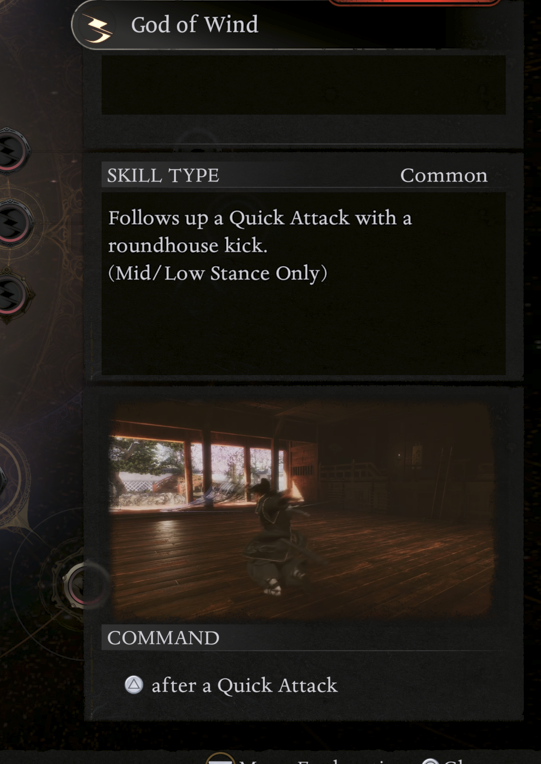
The Dual Swords play like a Samurai-style approximation of what Ninja weapons feel like — faster than every other option in the Samurai roster, with rapid multi-hit chains that build Ki damage through accumulated pressure rather than individual heavy swings. Their speed means you're almost always generating Arts Proficiency uptime, and Arts Proficiency directly amplifies the damage of their strongest Martial Arts. The Deflect counter-attack suite (Deflecting Cut, Windmill) turns successful parries into combo openers, rewarding aggressive read-and-react play at close range.
The Dual Swords' reference stats (Heart / Strength / Skill) create natural synergy with the Samurai Sword and, more importantly, overlap well with Dual Ninja Swords on the Ninja side — making the Heart-primary build one of the most cohesive cross-style setups in the game. At endgame, the Dual Swords' ability to rapidly stack elemental status effects (their multi-hit chains apply accumulation per hit) makes them a strong candidate for Confusion loop setups when paired with appropriate Onmyo Talismans. Game8 rates the full Dual Swords build at B-tier on their builds list specifically because it relies on Onmyo utility to reach its peak — the weapon itself alone is solidly A, but its best performance requires investment outside the weapon's own skill tree.
Best Martial Arts:
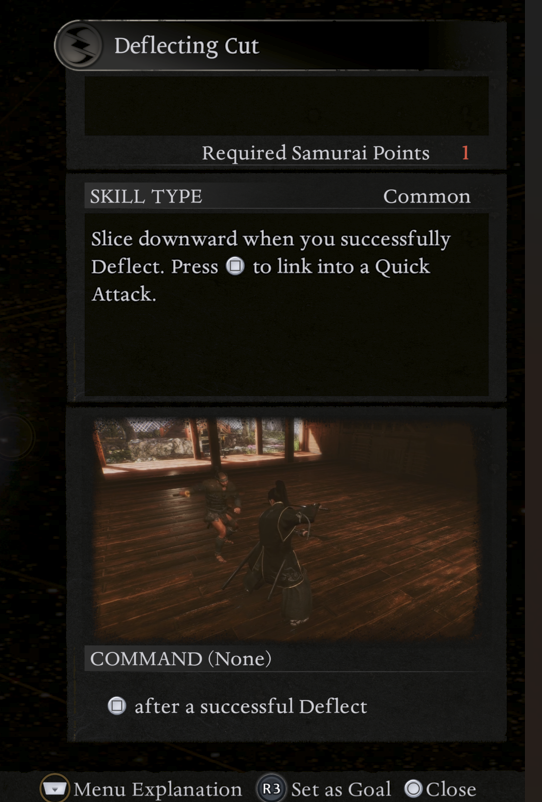
- Deflecting Cut — Immediate counter-attack following a successful Deflect. The keystone of Dual Swords counter-offensive play — parry, then punish instantly.
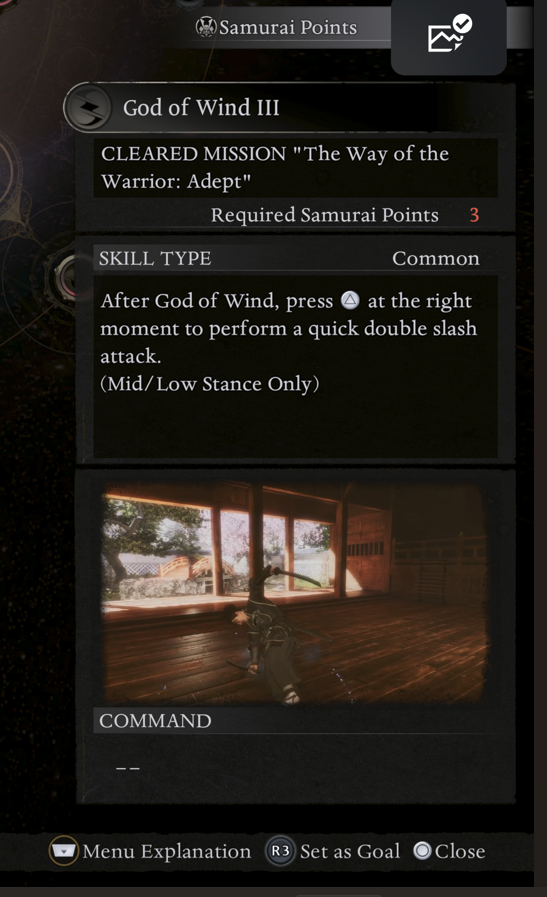
- God of Wind — Rapid multi-hit combo string that chains from standard attacks. Highest sustained DPS option in the Dual Swords toolkit.
- Windmill — Area spin attack that hits surrounding enemies. Best crowd control tool and a natural combo continuation after opening chains.
- Heaven and Earth — Aerial follow-up that keeps combos going after launching an enemy. Extends pressure upward against large or staggered targets.
Best for: Players who want the fastest Samurai option. Players who value the deflect-counter timing system and want to build a playstyle around it. Cross-style builds pairing with Dual Ninja Swords for Heart-primary shared scaling. Status effect builds leveraging multi-hit accumulation.
Avoid if: You prefer deliberate, spaced combat rather than maintaining constant close-range pressure. The Dual Swords heavily reward staying inside enemy attack range, which is the riskiest position to maintain consistently.
B-Tier Samurai Weapons
Sword — Best Samurai Weapon for Learning the Game
The Sword earns its B-tier placement not because anything about it is bad, but because it occupies the "jack of all trades" position in a roster where specialization pays off more than generality. It teaches every core Samurai mechanic correctly — stance flow, Deflect timing, Ki Pulse rhythms, the relationship between High/Mid/Low attack patterns — and does so with forgiving timing windows and no punishing failure states. It's the right starting weapon for players new to Nioh 3 or the series entirely.
Where the Sword falls behind is in what it doesn't do better than alternatives at equivalent skill level. The Spear is safer at range. The Dual Swords are faster and deal more pressure damage. The Switchglaive has a dramatically higher ceiling once stance-morphing is mastered. The Sword doesn't dominate any category — it's competent across all of them. In Dream of the Nioh difficulty, where enemy aggression and damage reach their peak and builds need to be optimized, the Sword's lack of specialization becomes a meaningful liability. The Lightning Sword build is a genuine S-tier early-game setup (Heart 40 for Ki pool and damage, Lightning Talismans for elemental pressure, Heaven Flash as the core Martial Art) but transitions into other weapons more naturally than it evolves into a full endgame Sword build.
Best Martial Arts:
- Heaven Flash — Fast forward-lunging strike with high damage that works from every stance. The Sword's premier offensive Martial Art and the core of the Lightning Sword early build.
- Kurama Sword Dance — Multi-hit combo burst with solid damage and easy execution. Natural follow-up to opened-up enemies.
- Blade Spin — Spinning area attack that creates space and deals multi-hit damage. Strong against groups and as an emergency crowd-control option.
- Crossing Blades — Deflect-enhanced counter strike with high stagger value. Pairs with the Sword's Deflect system for consistent punish setups.
Best for: First-time Nioh players learning the mechanics. Players who want a reliable, low-friction experience through the main campaign before deciding which direction to spec. The Lightning Sword early-game build — before transitioning to the Switchglaive or committing fully to another weapon.
Cestus — Best Samurai Weapon for Close-Range Specialists
The Cestus are fist weapons — new to Nioh 3 — and they occupy the Samurai equivalent of the Tonfa's role in Ninja style: a short-range, high-speed Ki destroyer that wins through relentless pressure and guard-breaking. The parallels are intentional. Cestus attacks hit fast, deal heavy Ki damage, and build toward the Winded state that opens grapple finishers. The Stomp + Pulverize combo is the signature sequence — land enough rapid strikes to drain enemy Ki, trigger the Winded vulnerability, then execute the finisher for disproportionate damage.
The B-tier placement comes down to two factors: range and competition. At the range the Cestus requires you to stay in, you're taking more hits than any other Samurai weapon playstyle — the Cestus rewards aggression but punishes overextension even more than the Axe does. And when the Tonfa exists on the Ninja side delivering similar Ki-destruction outcomes with better mobility tools (Demon Dance's extended i-frames, Evade-based Ki recovery), the Cestus needs to offer something the Tonfa doesn't to justify its risk profile. What it does offer is the Samurai stance system's power scaling — Cestus combos in High Stance deal significantly more raw damage per hit than the Tonfa does, making it genuinely useful against targets where Ki-breaking isn't the priority but burst damage is.
Best Martial Arts:
- Pulverize — The Cestus signature finisher. Activated off enemy Winded state for massive damage. Build every combo toward triggering this.
- Stomp — Ground slam that creates a brief stagger window and advances your position. Natural combo lead-in to Pulverize sequences.
- Mountain Breaker — Dashing forward strike that covers distance and deals area damage on impact. The Cestus's answer to fighting enemies who try to back away from close range.
- Raging Fists — Rapid multi-hit burst during Arts Proficiency that demolishes enemy Ki in seconds. The highest single-window Ki damage output the Cestus can achieve.
Best for: Players who want to punch everything. Players comfortable living at zero-range and managing the higher hit-exposure that requires. Cestus + Tonfa cross-style pairing for a full Ki-destruction build across both styles. Anyone who mastered the Tonfa and wants to bring the same philosophy to the Samurai side.
Avoid if: You want flexibility in positioning. The Cestus at the wrong range is the most punished weapon in the Samurai roster.
Which Samurai Weapon Is Right for You?
The fastest way to pick: identify which of these combat problems you most want to solve, and match it to the weapon that solves it best.
| Your Priority | Best Pick | Why |
|---|---|---|
| I want to learn Nioh 3 without fighting the weapon | Spear or Sword | Forgiving mechanics, straightforward combos, best range safety |
| I want the highest possible damage ceiling | Switchglaive | Stance-morph loop + Onmyo integration = best endgame DPS |
| I want to hit things very hard with minimal complexity | Odachi | Highest damage-per-swing, wide arcs, crowd control built-in |
| I want fast, relentless pressure | Dual Swords | Fastest Samurai option, deflect counters, multi-hit Ki pressure |
| I want to stagger and Ki-break everything | Axe or Cestus | Axe for ranged guard-break power; Cestus for close-range Ki-destruction |
| I want the best cross-style weapon pairing | Spear (pair with Tonfa) | Shared Constitution + Skill = most stat-efficient pairing in the game |
| I'm a Nioh veteran who wants to master the new system | Switchglaive | Deepest mechanical expression of the three-stance system in the game |
- Nioh 3 Best Weapons Tier List — Full S-through-B rankings for all 14 weapons with combat breakdowns. Use this to decide which weapon is worth your stat investment before committing.
- Nioh 3 Tonfa Build Guide — The S-tier Ninja weapon, fully built out. Two complete build paths (Ki-Destruction and Elemental Status), armor progressions, Guardian Spirits, and Soul Core recommendations from Act 1 through Dream of the Nioh.
- Nioh 3 Review — Metacritic 86, OpenCritic 88. Full verdict on whether the full game justifies the investment beyond the demo.
- Nioh 3 Character Creation Codes — All working PS5 and PC codes if you're still perfecting your character's look before diving deep into the build grind.
Câu hỏi thường gặp về Nioh 3
- Ngày phát hành Nioh 3 là khi nào?
- Nioh 3 dự kiến phát hành vào ngày 6/2/2026.
- Nioh 3 chơi được trên nền tảng nào?
- Nioh 3 hỗ trợ: PC (Microsoft Windows), PlayStation 5.
- Nioh 3 thuộc thể loại gì?
- Nioh 3 thuộc thể loại: Role-playing (RPG), Hack and slash/Beat 'em up, Adventure.
- Có trailer chính thức của Nioh 3 không?
- Có. Bạn có thể xem trailer của Nioh 3 ngay trên trang này ở phần video.
Khám phá thêm
Nioh 3 Tonfa Build Guide: Best Endgame Setup for Dream of the Nioh
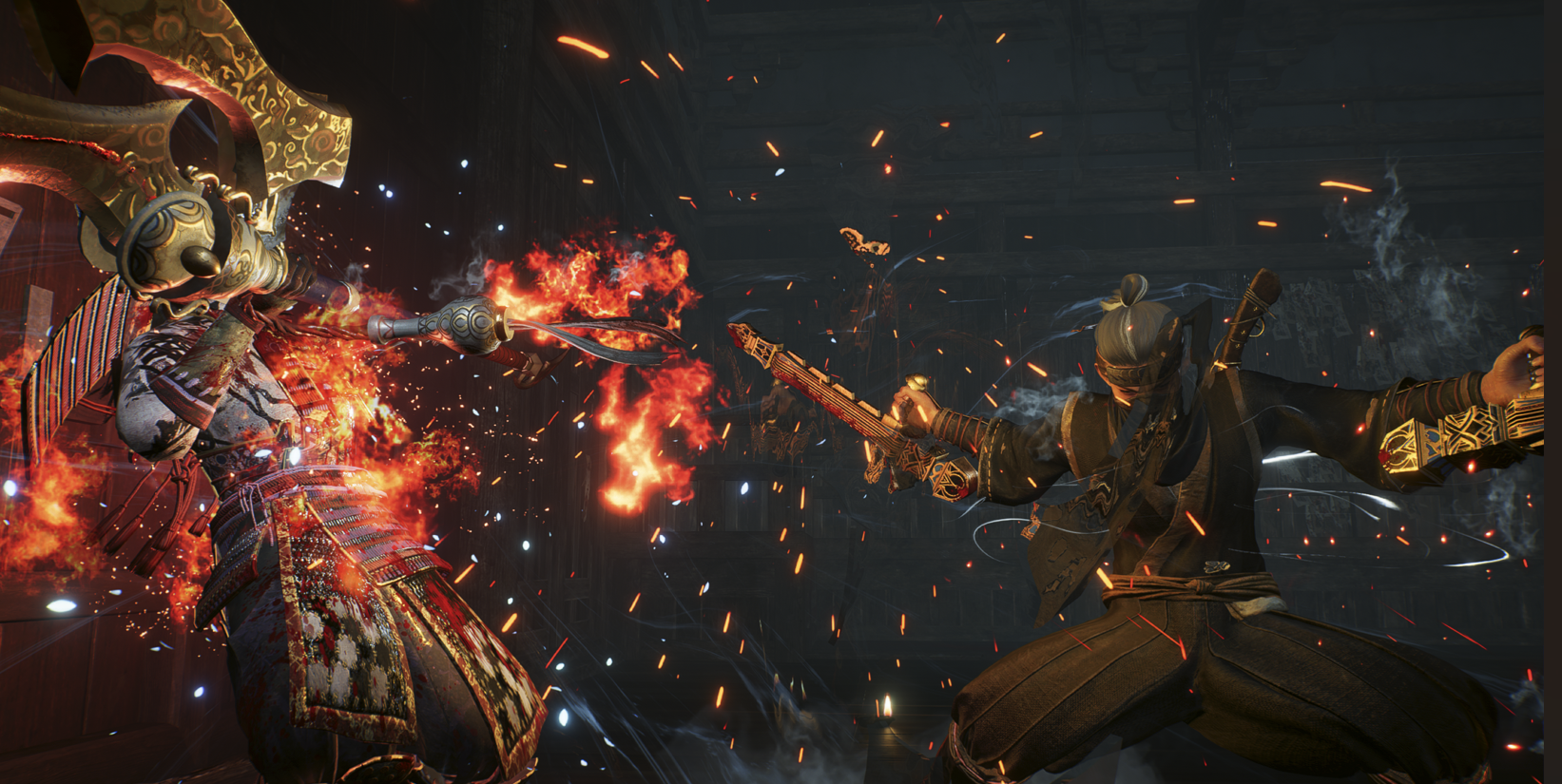
The Tonfa is Nioh 3's highest Ki-damage Ninja weapon — a blunt, fast, relentless close-range weapon that wins by draining enemy stamina bars faster than they can recover, forcing Winded states, and capitalising on those vulnerability windows with finishing moves that deal disproportionate burst damage. In the base game, a halfway-decent Tonfa setup will stagger-lock most enemies before they can threaten you. In Dream of the Nioh — where enemy health pools triple, their damage can one-shot you, and your basic combat tools stop being enough — the Tonfa build stops being about hitting hard and starts being about engineering a system.
Nioh 3 Weapons Scaling Guide: Which Stats to Level for Each Weapon
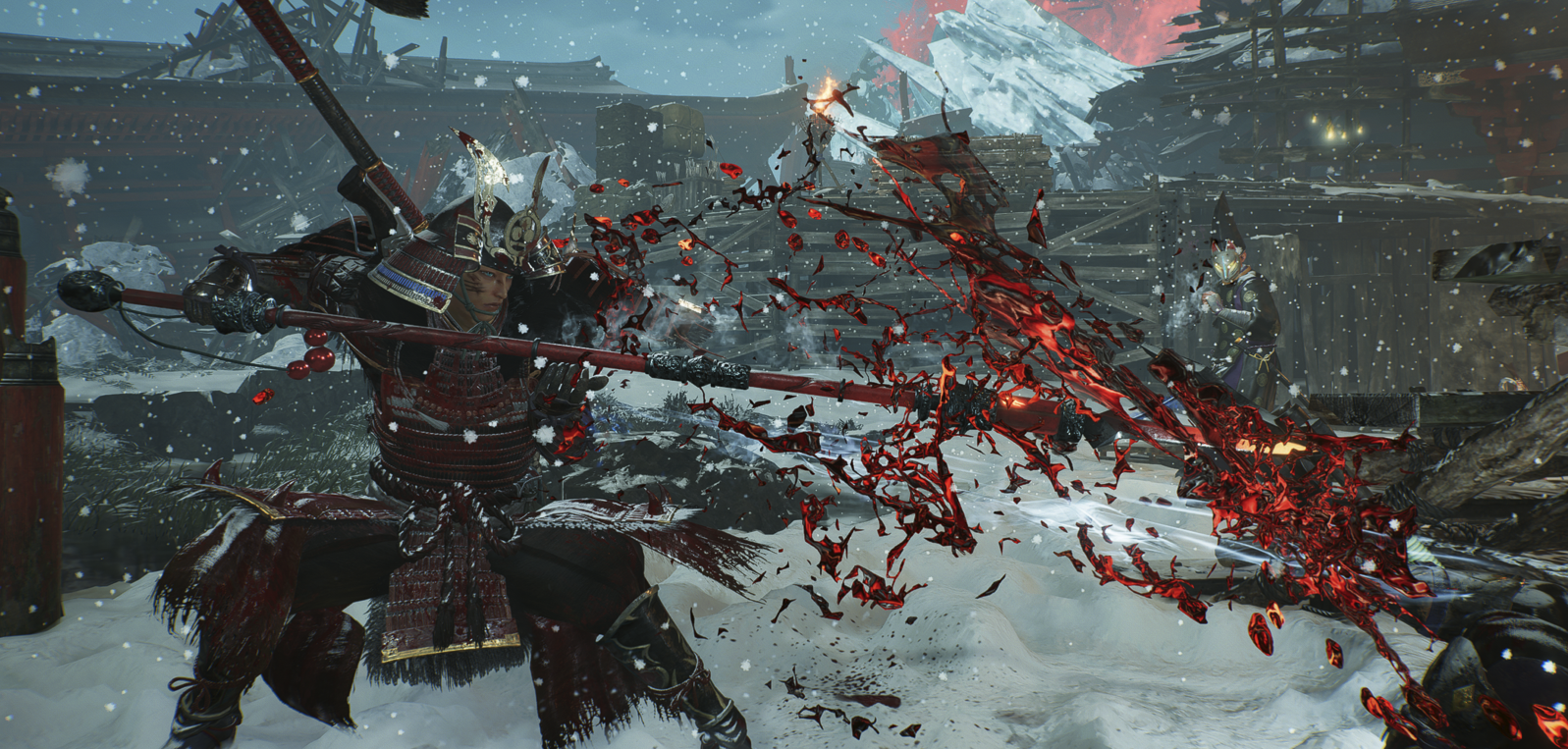
Nioh 3 throws out the letter-grade scaling system from Dark Souls and Elden Ring entirely. There are no A/B/C rankings stamped on your weapon telling you to just pump Strength. Instead, every weapon in the game operates on what Team Ninja calls Reference Stats — a three-stat dynamic scaling system that automatically adjusts to your highest attribute investment. It sounds complex. It is, slightly. But once you understand how it works, it becomes one of the most build-friendly systems in any Souls-adjacent game, because it's nearly impossible to permanently brick your character — and respec is free.
Nioh 3 Character Creation Guide: Best Character Codes, Sliders & Tips (PS5 & PC)
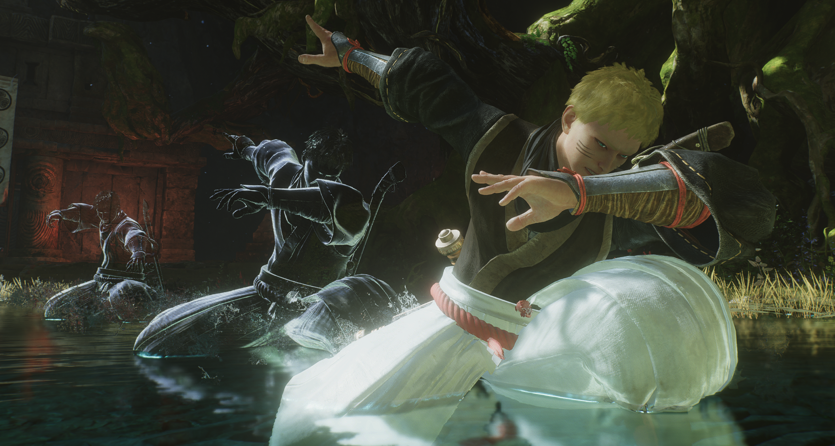
Before a single Yokai dies, before you settle on your first weapon, before you even decide whether you're building Samurai or Ninja — you'll be staring at the Nioh 3 character creation screen deciding what your warrior actually looks like. And given that Team Ninja has built one of the most detailed character customization systems in the Souls-like genre, that time investment is entirely justified. Whether you want to craft an original face from scratch or import one of the community's best Nioh 3 character codes to get straight into the action, this guide covers everything: every menu, all the working codes for both PS5 and PC, and tips for getting the most out of the system.
Nioh 3 Tonfa Build Guide: Best Stats, Skills, Armor, and Combos
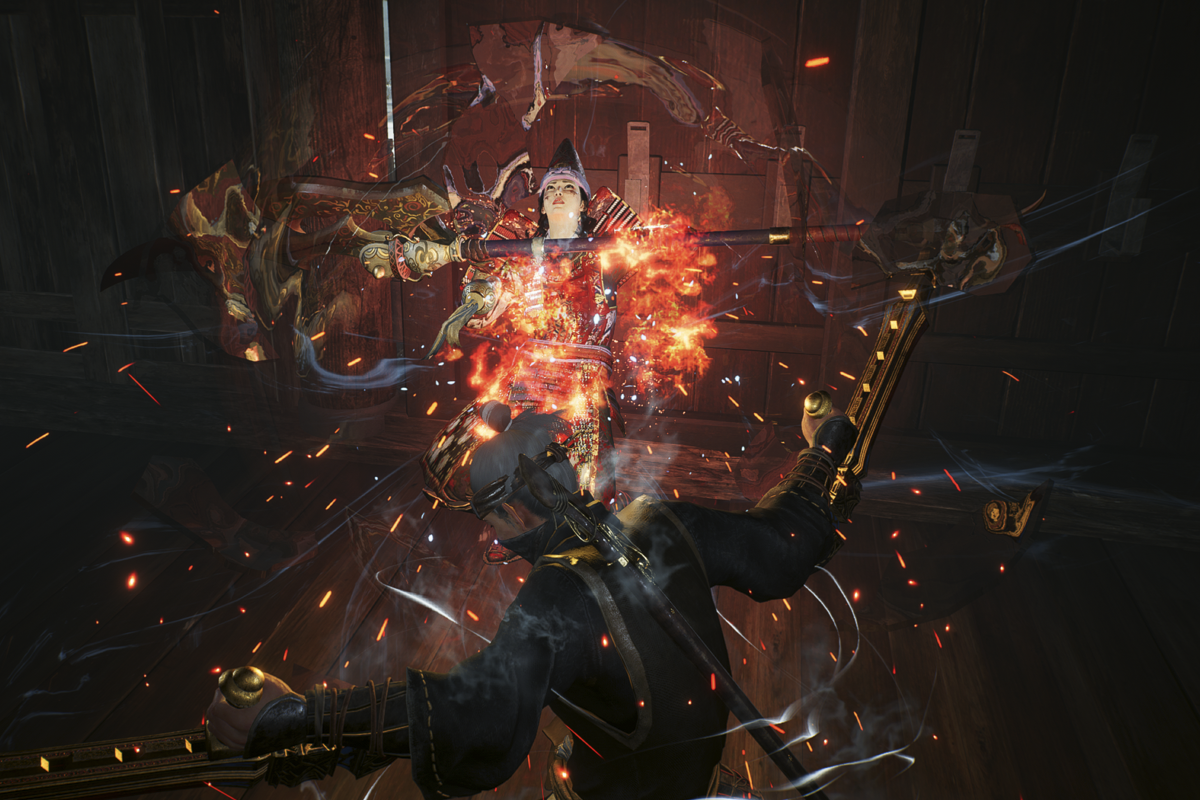
The Tonfa is the best Ninja weapon in Nioh 3, and it isn't particularly close. No other weapon in the entire game — Samurai or Ninja — drains enemy Ki as fast, chains into sustained multi-hit combos as efficiently, or punishes a staggered boss with the same relentless pressure. It holds the top spot in our Nioh 3 weapon tier list, sits at the core of countless endgame builds, and earns its S-tier position in every credible Nioh 3 best weapons ranking for a reason that becomes obvious the moment the build clicks: when an enemy's Ki bar hits zero and they collapse into a grapple window, the Tonfa put them there in roughly half the time any other weapon would have.