
Path of Exile 2 Martial Artist Guide
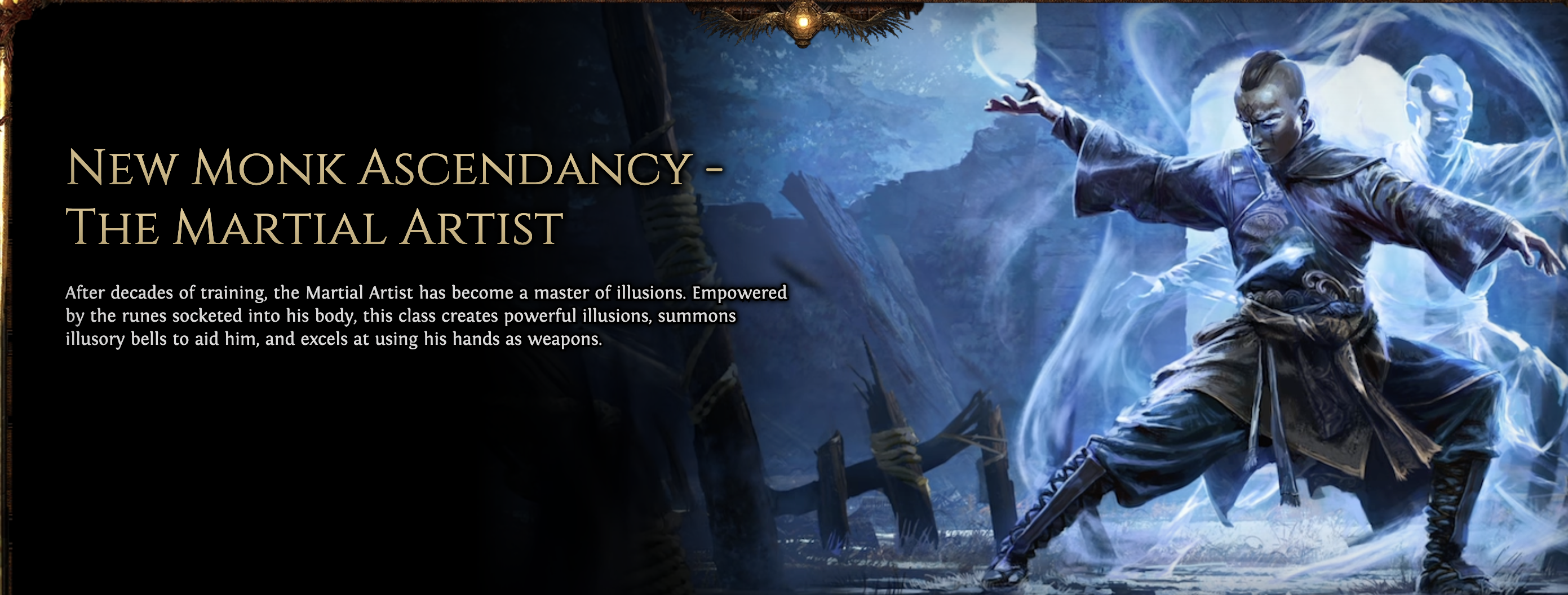
The Martial Artist rewards players who understand PoE 2's combat geometry. Bells need to be struck. Clones need positioning. Glove scaling means your gear choices matter differently than on any other build. This isn't a passive-stack ascendancy where you pick nodes and forget them. Every mechanic here has an active component.


Martial Artist — The Monk Ascendancy That Changes Everything
Introduced in the 0.5.0 Return of the Ancients update, the Martial Artist is the Monk's new Ascendancy built around three interlocking ideas: illusion mechanics, rune-powered body enhancement, and turning your gloves into the most dangerous weapons in the game.
What separates Martial Artist from Invoker and Acolyte of Chayula isn't just the mechanics — it's the identity. This is the unarmed, bell-summoning, clone-spawning ascendancy. Every major node feeds into a cohesive loop rather than bolting on unrelated bonuses. You'll feel that coherence from the moment you hit your first Ascendancy lab.
The three pillars are worth naming upfront:
- Hollow Technique — bell summoning, bell resonance, and the Hollow Form channel skill that spawns illusion clones to fight alongside you
- Way of the Stonefist — your equipped gloves transform entirely, converting their modifiers into stronger versions and scaling both offence and defence through your fists
- Runic Meridians — five additional rune-only sockets outside your gear, giving you a customisation axis no other Monk ascendancy has access to
Each of those pillars has its own section in this guide. But before we get into nodes and numbers, it's worth understanding why this ascendancy is generating so much pre-launch discussion — and why it's the one I'd point a day-one player toward without hesitation.
The Martial Artist rewards players who understand PoE 2's combat geometry. Bells need to be struck. Clones need positioning. Glove scaling means your gear choices matter differently than on any other build. This isn't a passive-stack ascendancy where you pick nodes and forget them. Every mechanic here has an active component.
That sounds like more work. It is. But the payoff — both in damage ceiling and in how satisfying the gameplay loop feels — makes it worth every bit of it.
Who This Guide Is For
This is a comprehensive breakdown of the Martial Artist Ascendancy — mechanics, node analysis, build synergies, and practical recommendations. Whether you're planning your league start or theorycrafting endgame, there's something here for you. We're not going to hold your hand through basic Monk fundamentals, but we will explain every Martial Artist-specific mechanic in full detail.
Let's get into it.
Hollow Focus — Build Synergies That Actually Matter
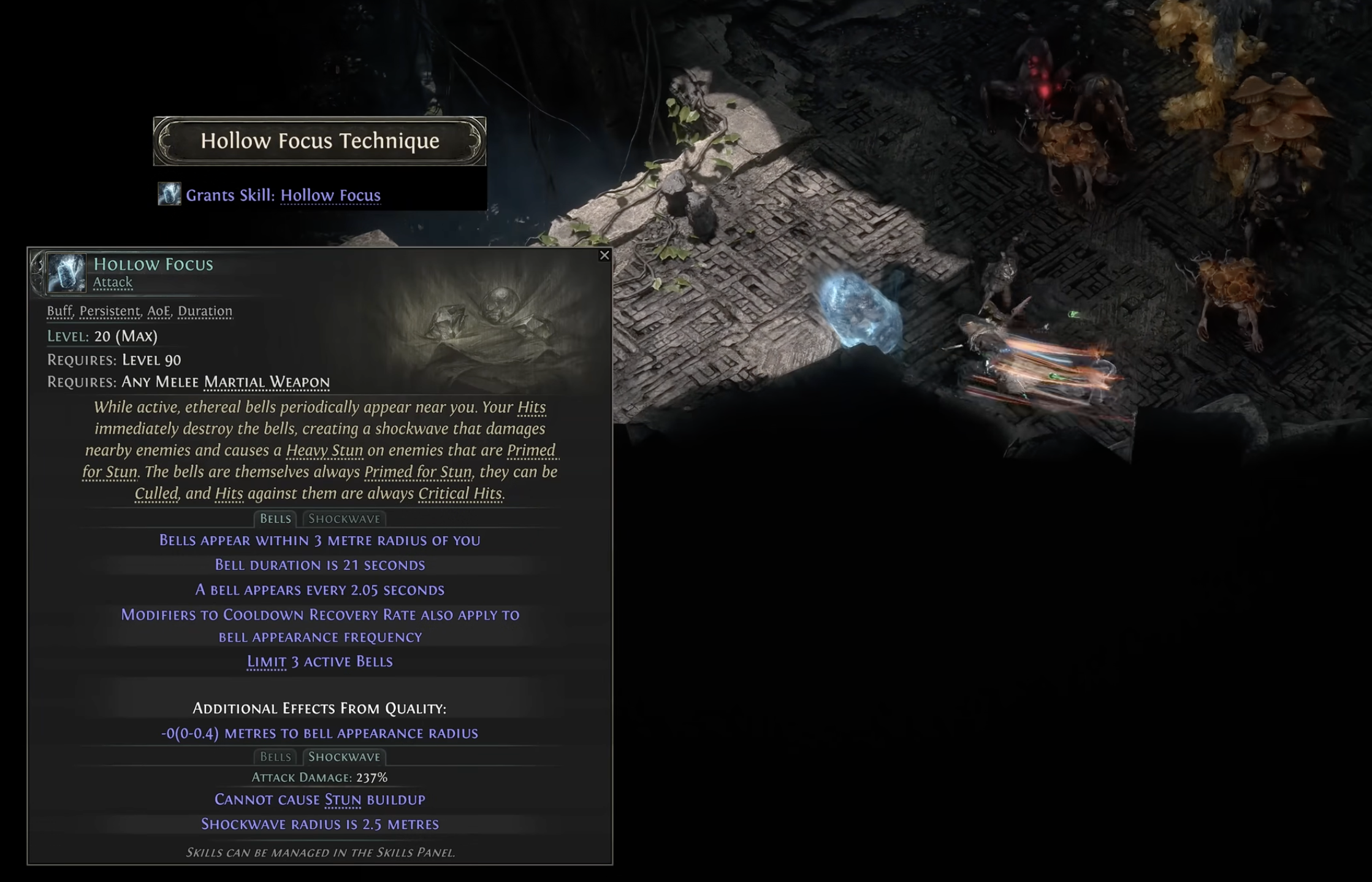
Let's be direct: Hollow Focus isn't just a passive buff you slot in and forget. Every single mechanic on this skill feeds into something else. The bell appears every 2.05 seconds, lasts 21 seconds, caps at 3 active bells — and every one of those bells is always Primed for Stun, always Cullable, and always guarantees a Critical Hit when you land a hit on it. That's not one synergy. That's a synergy stack.
The Crit Loop
Hits against bells are always Critical Hits. Full stop. For any build investing in crit scaling — crit multiplier, crit damage supports, Assassin's Mark, whatever — every bell destruction is a guaranteed proc. You're not fishing for crits on the bell. You're printing them. Stack crit multi high enough and each shockwave detonation hits like a truck, not a tap.
The shockwave itself deals 237% Attack Damage and has a 2.5 metre radius. That's meaningful AoE, not cosmetic splash. Against tight packs, one bell pop can clip four or five enemies simultaneously — all with that guaranteed crit modifier applied.
Stun Synergy — Reliable, Not RNG
The shockwave causes Heavy Stun on enemies that are Primed for Stun. Pair that with the Monk's natural stun-building toolkit — Staggering Palm, the Resonance passive keystone, or any stun threshold investment — and you have a near-guaranteed stun source every couple of seconds. Bosses included.
This matters enormously for the hit-and-stun rhythm that melee Monk lives by. You're not waiting for a stun to line up. The bell does it for you on a timer.
Power Charge Engine
Destroy a bell, generate power charges. Community builds running the Resonance keystone — which converts frenzy charges into power charges — combined with Combat Frenzy create a self-sustaining charge loop that Hollow Focus feeds directly. More bells destroyed means more charges cycled, which means more Falling Thunder procs, more damage windows, more everything.
It's not complicated. It's just efficient.
Cooldown Recovery Rate Doubles as Bell Speed
Here's the one most people miss on first read: Modifiers to Cooldown Recovery Rate also apply to bell appearance frequency. Any CDR investment — on gear, passives, supports — directly tightens that 2.05-second spawn interval. More bells per minute means more shockwaves, more crits, more stuns. CDR stops being a defensive-flavour stat and becomes offensive throughput for this build specifically.
Culling Interactions
Bells can be Culled. If you're running any culling mechanic — Killing Palm with culling supports, gear with culling strike — the bell itself becomes a valid Cull target. This unlocks additional on-kill or on-cull bonuses depending on your support links. Niche? Yes. Worth knowing? Absolutely, especially if Killing Palm is already in your kit for power charge generation.
Quick Reference — Bell Mechanics at a Glance
| Mechanic | Value / Behaviour |
|---|---|
| Bell appearance radius | 3 metres around you |
| Bell duration | 21 seconds |
| Spawn interval | Every 2.05 seconds |
| Active bell limit | 3 |
| Shockwave Attack Damage | 237% |
| Shockwave radius | 2.5 metres |
| Hits vs bells | Always Critical Hits |
| CDR scaling | Also reduces spawn interval |
Hollow Focus rewards builds that already want crit, already want stuns, and already want power charges. It doesn't ask you to build around it — it plugs into the Monk's existing framework and amplifies everything simultaneously. That's what makes it dangerous in 0.5.
Hollow Resonance Technique — Martial Artist's New Bell Mechanic
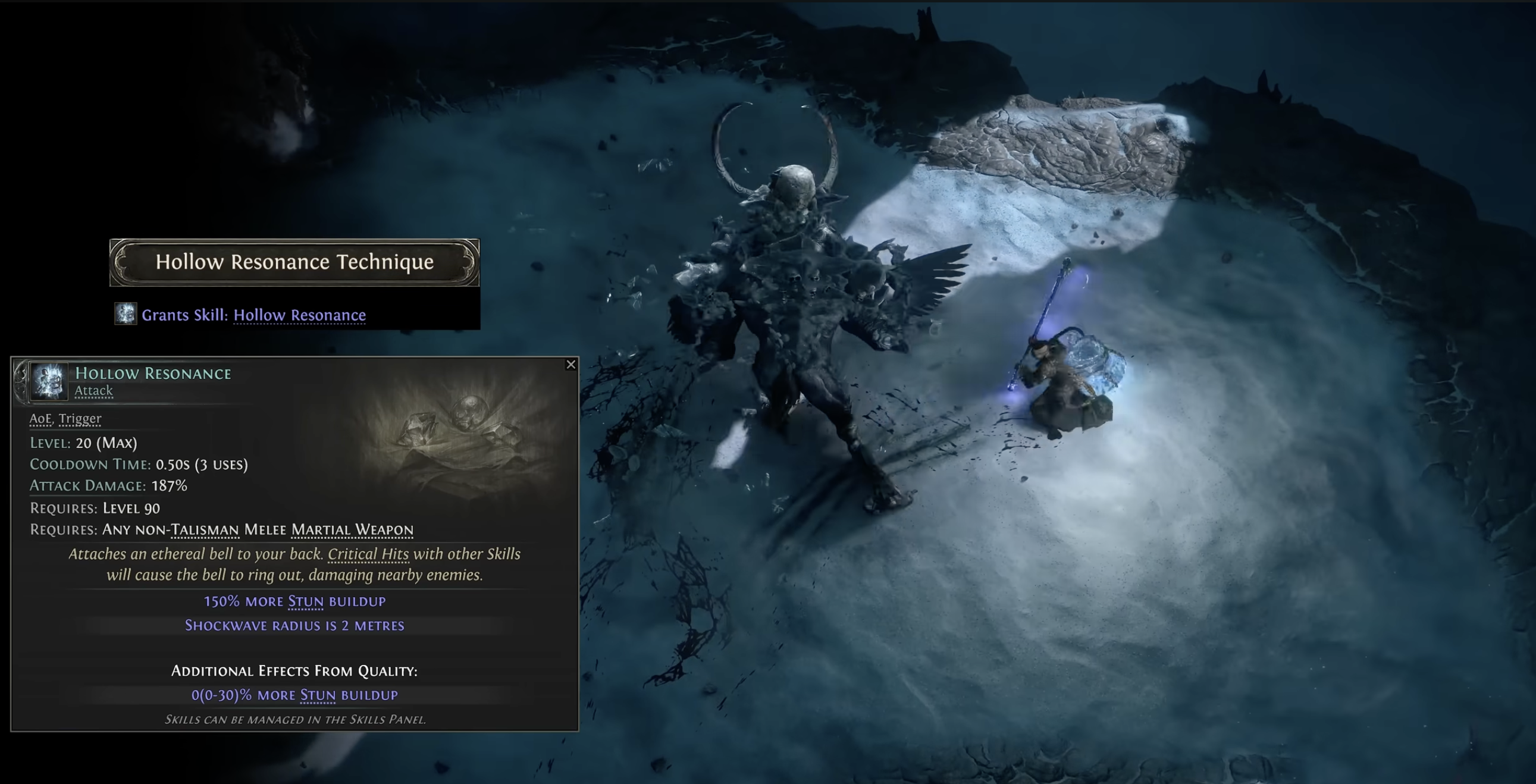
This is one of the most quietly powerful additions in the 0.5 Martial Artist Ascendancy. Hollow Resonance Technique grants the Hollow Resonance skill — an AoE Trigger Attack that attaches an ethereal bell to your back. Level 20 (max), 0.50s cooldown with 3 uses, 187% Attack Damage, requires Level 90 and any non-Talisman Melee Martial Weapon. The bell rings out a shockwave whenever you land a Critical Hit with other skills, dealing damage to nearby enemies with 150% more Stun Buildup and a shockwave radius of 2 metres.
No more manually placing bells. The bell is just there. Always.
That one change alone solves a fundamental rhythm problem the old Bell Monk had — you were constantly juggling placement timing mid-fight, especially against mobile bosses. Now your Critical Hits do the work automatically.
Why the Crit Synergy Matters So Much
The trigger condition is Critical Hits with other skills. So every time your main attack crits, the bell fires a free AoE shockwave with massive Stun Buildup baked in. On a boss fight, this compounds fast. Stack enough Crit Chance and you're essentially getting near-continuous shockwave pulses staggering the target — which feeds directly into Heavy Stun windows where your damage explodes.
The community consensus is clear: this resolves the old Monk's biggest bossing weakness. Stun-locking endgame bosses was inconsistent before. Now it's a genuine strategy.
Build Synergies Worth Theorycrafting
A few directions stand out immediately:
- Way of the Stonefist + Hollow Resonance: The most natural pairing. Invest hard into Stun Buildup nodes on the passive tree, and the bell's 150% more Stun Buildup becomes a reliable stagger engine. Every crit rings the bell, every ring pushes the stun meter — bosses spend more time stunned than attacking.
- Killing Palm charge generation: Killing Palm generates Power Charges on kill. More Power Charges means higher Crit Chance. Higher Crit Chance means the bell rings more. It's a self-reinforcing loop that gets nastier the further into a map you go.
- Hollow Form + Whirling Assault: Hollow Form enables Channeling Skills, and Whirling Assault is a monster of a channeled option. Channel into a pack, crit repeatedly, bell fires on every proc — the AoE coverage becomes absurd. Community theory suggests this could be one of the stronger mapping combos in 0.5.
- Black Insignia + Tailwind: Tailwind grants Skill Speed and Evasion Rating, both excellent on a melee Monk. Faster skill speed means more hits per second, more crits per second, more bell rings. The scaling gets out of hand quickly.
The Weapon Restriction — And Why It's Fine
Requires any non-Talisman Melee Martial Weapon. That's a broad pool — maces, quarterstaffs, claws, swords all qualify. Notably, this opens the Monk to mace skills for the first time in a meaningful way. Mace-based slam builds with Heavy Stun synergy and the bell's Stun Buildup bonus? Theoretically terrifying for bossing.
The Talisman exclusion is deliberate — Talisman weapons are shapeshifting tools for Hollow Form's transformation builds, so they get their own lane.
Quality Scaling
At max quality, Hollow Resonance gains an additional 0–30% more Stun Buildup on top of the base 150%. Not a game-changer by itself, but on a build already committing to Stun as a primary boss mechanic, that extra ceiling matters for the most demanding endgame encounters.
Bottom line: Hollow Resonance Technique is the kind of passive that quietly defines a playstyle. It doesn't look flashy on paper — a bell on your back, a shockwave on crit. But the moment you build around it properly, it becomes the engine that makes everything else tick.
Runic Meridians — Five Free Rune Slots
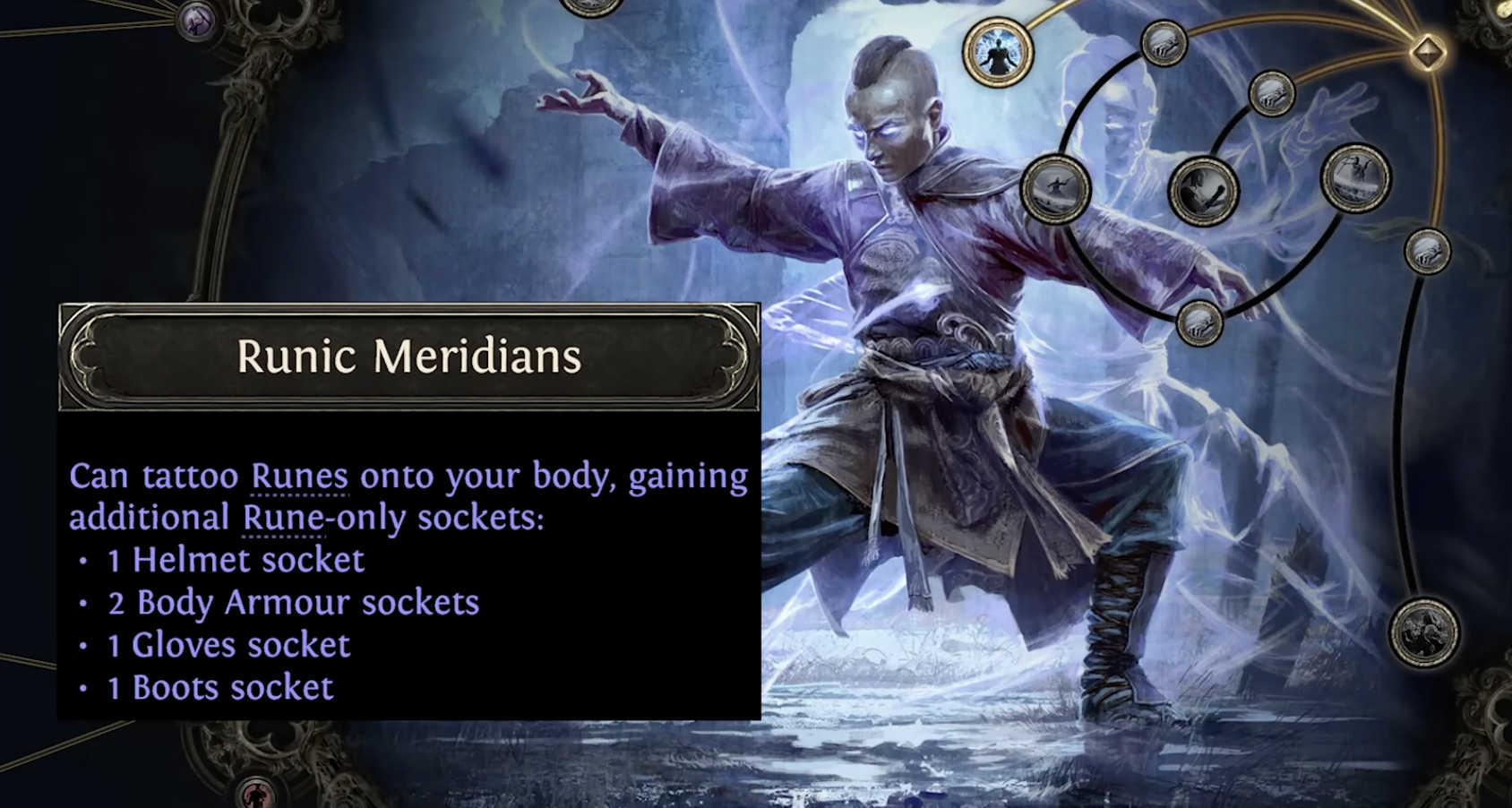
Simple node. Massive upside. Runic Meridians lets you tattoo Runes directly onto your body, adding Rune-only sockets across your gear slots — no item affixes consumed, no trade-offs on your existing gear.
The breakdown is exactly what the tooltip shows:
- 1 Helmet socket
- 2 Body Armour sockets
- 1 Gloves socket
- 1 Boots socket
Five extra Rune slots, total. These are Rune-only — you can't socket Jewels here — but that's fine, because that's exactly what you want them for.
Why This Matters for Martial Artist Specifically
The Martial Artist has a gearing problem that most builds don't. Way of the Stonefist transforms your gloves into Fists of Stone, and if you're running a Hollow Palm-style setup, your weapon slot is essentially gone. That's a lot of potential stat budget evaporating. Resistances, life, utility — all of it becomes harder to source from gear alone.
Runic Meridians is the answer.
Fill the body slots with Life Runes. Dump resistance Runes into helmet and boots. Suddenly your actual gear affixes — the ones that cost currency to craft or acquire — can focus entirely on damage. Attack speed. Crit. Evasion. Energy Shield. The stats that actually move your numbers.
The Jewel Socket Angle
Community theorycrafting around 0.5 has flagged an interesting interaction worth keeping in mind: the new league mechanic that lets you convert Rune sockets on gear into Jewel sockets. Normally that's a painful trade-off — you lose a Rune slot to gain a Jewel slot. But with Runic Meridians covering five dedicated Rune sockets on your body, you can afford to make that conversion on your gear more aggressively without gutting your stat baseline.
If you're chasing a high-jewel setup — say, something built around The Adorned with magic jewels — Runic Meridians is what makes that remotely feasible without your resistances collapsing. Pure theory at this stage, but the logic holds.
League Starter Value Is Real
Endgame theorycrafting aside, the practical value of this node shows up earliest in the campaign and early maps. Stat gaps — missing resistances, not enough life, patchy crit — are exactly the kind of problems Runes solve cheaply. Five extra slots means five problems you can fix without spending a single Exalted Orb on gear upgrades.
For league start, this node essentially buys you time. Time to find better gear, time to craft properly, time to push into higher-tier content without dying to a resistance check you forgot to fill. Not glamorous. Absolutely worth taking.
| Slot | Additional Rune Sockets |
|---|---|
| Helmet | 1 |
| Body Armour | 2 |
| Gloves | 1 |
| Boots | 1 |
| Total | 5 |
Way of the Stonefist — The Reason Everyone Is Losing Their Mind
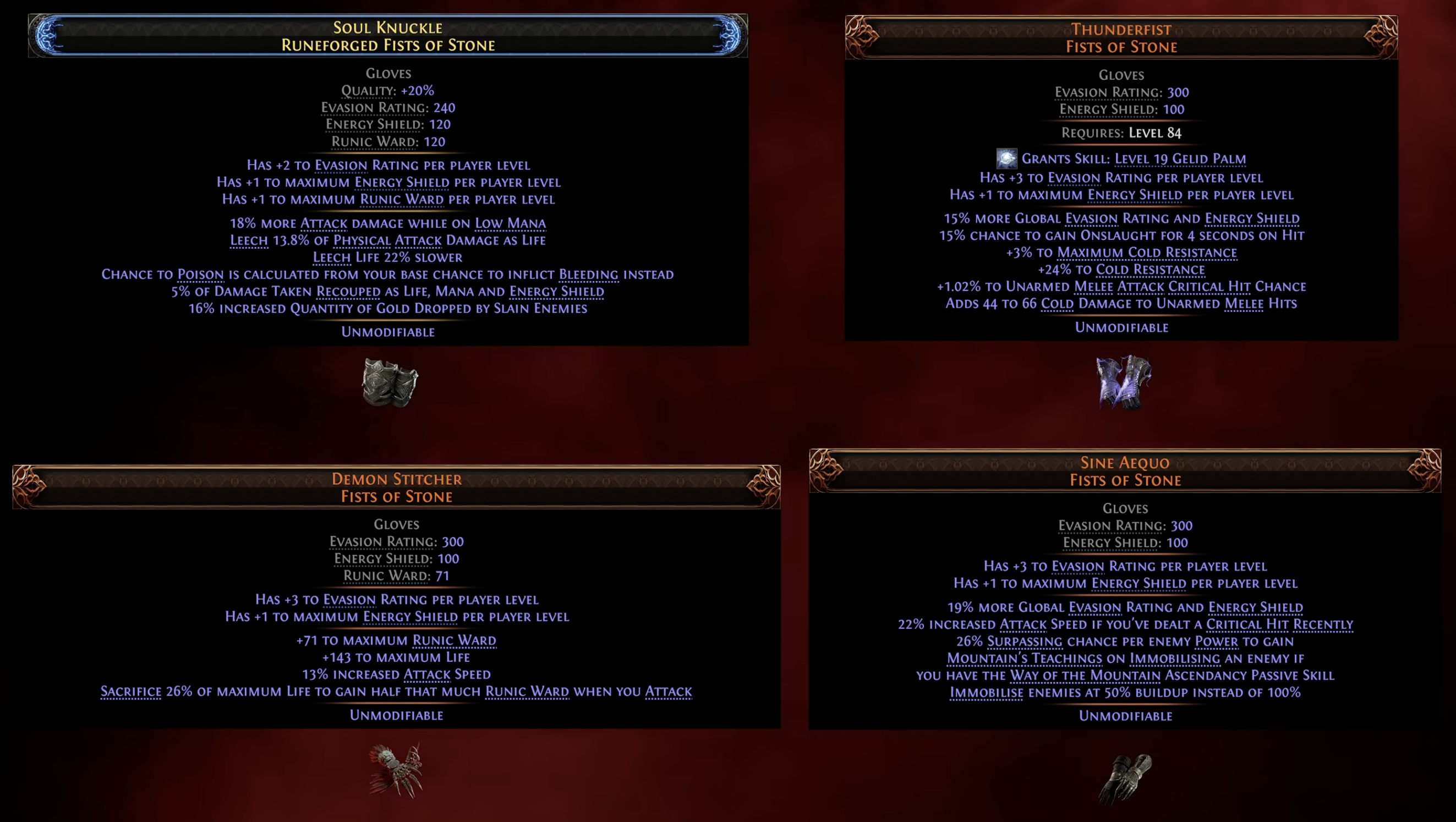
Everything else in the Martial Artist kit is strong. Hollow Focus, the bell mechanics, Runic Meridians — all excellent. But Way of the Stonefist is the node that has the entire Path of Exile 2 community in a frenzy, and looking at these four Fists of Stone gloves side by side, it's not hard to see why.
The mechanic is deceptively simple: equip any pair of gloves, and Way of the Stonefist converts their base type to Fists of Stone. Every prefix and suffix gets transformed into a more powerful related modifier. The gloves also gain +3 Evasion Rating per player level and +1 to maximum Energy Shield per player level as implicit stats. Unequip them and they revert. The transformation is reversible — but why would you ever go back?
Look at what's on screen. These aren't theoretical numbers.
| Item | Notable Converted Mods | Base Defensive Stats |
|---|---|---|
| Soul Knuckle (Runeforged) | 18% more Attack Damage on Low Mana, 13.8% Physical Attack Damage as Life, 5% Damage Taken Recouped as Life/Mana/ES | Evasion 240, ES 120, Runic Ward 120 |
| Thunderfist | Grants Level 19 Gelid Palm, 15% more Global Evasion and ES, 15% Onslaught on Hit, +3% Max Cold Resistance, Adds 44–66 Cold Damage to Unarmed Melee Hits | Evasion 300, ES 100 |
| Demon Stitcher | +71 max Runic Ward, +143 max Life, 13% increased Attack Speed, Sacrifice 26% max Life to gain half that Runic Ward on Attack | Evasion 300, ES 100, Runic Ward 71 |
| Sine Aequo | 19% more Global Evasion and ES, 22% increased Attack Speed after Crit, 26% Surpassing Power Charge chance, Mountain's Teachings on Immobilise (Way of the Mountain synergy), Immobilise at 50% buildup | Evasion 300, ES 100 |
That Sine Aequo entry deserves a second look. Immobilise enemies at 50% buildup instead of 100% — that's a direct multiplier on how fast you generate Mountain's Teachings stacks. Combine that with 22% increased Attack Speed after a Critical Hit and 26% Surpassing chance per enemy Power to gain a Power Charge, and you have a glove that feeds every single other system in the Martial Artist kit simultaneously. One item slot doing the work of three.
And Thunderfist is handing out a Level 19 Gelid Palm as a granted skill. On gloves. That were originally just regular gloves before Way of the Stonefist touched them.
This is the part that has the community genuinely alarmed — in the best and worst ways. The transformation doesn't just add stats. It converts ordinary affixes into categorically different and stronger modifiers suited to Monk's unarmed playstyle. Cold damage to unarmed hits, maximum resistance bonuses, attack speed tied to crit — these aren't random. They're purpose-built. The concern circulating online is that GGG may not have fully stress-tested what happens when a well-itemised pair of endgame gloves goes through this conversion.
The hype is real and it started early. Community theorycrafters have been dissecting every revealed Fists of Stone item since the 0.5.0 patch preview dropped, and the consensus is unanimous: Way of the Stonefist is the strongest single Ascendancy node shown for any class in this patch cycle. Some are calling it the most powerful glove-slot mechanic in Path of Exile 2's history so far. That might be hyperbole. Probably isn't.
The broader meta implication is significant. Every other Monk Ascendancy — Invoker, Acolyte of Chayula — has a clearly defined identity. Martial Artist's identity is "your gloves become absurdly good and everything else in your kit scales off that." It's less a subclass and more a damage amplifier wearing the skin of one.
One important caveat: these numbers are from pre-launch testing and community previews ahead of the May 29th live date. GGG has a history of tuning nodes between reveal and release. Way of the Stonefist, specifically, has been flagged by multiple community voices as a likely nerf candidate before or shortly after the patch goes live. The affix conversion mechanism — turning generic physical or elemental damage affixes into unarmed-specific, percentage-based power modifiers — is the kind of thing that looks fine in isolation and breaks open in practice.
Enjoy the current numbers while you can. They may not survive contact with the playerbase.
Why This Node Cements Martial Artist as the Day-One Ascendancy to Watch
Every guide will tell you Runic Meridians is great value. It is. Every guide will tell you the bell mechanics are clever. They are. But Way of the Stonefist is the reason Martial Artist is going to be the most-played Monk Ascendancy on launch day, and probably the first one GGG patches in 0.5.1.
The defensive scaling alone — +3 Evasion and +1 max Energy Shield per player level as a baseline on any gloves you equip — means your defensive floor goes up significantly just by taking the node. Then the affix conversion turns whatever offensive stats were already on those gloves into something tuned specifically for unarmed Monk combat. You're not choosing between offense and defense on this slot. You're getting both, amplified.
That's not balance. That's a gift. And the community knows it.
Martial Artist League Starter Build Guide
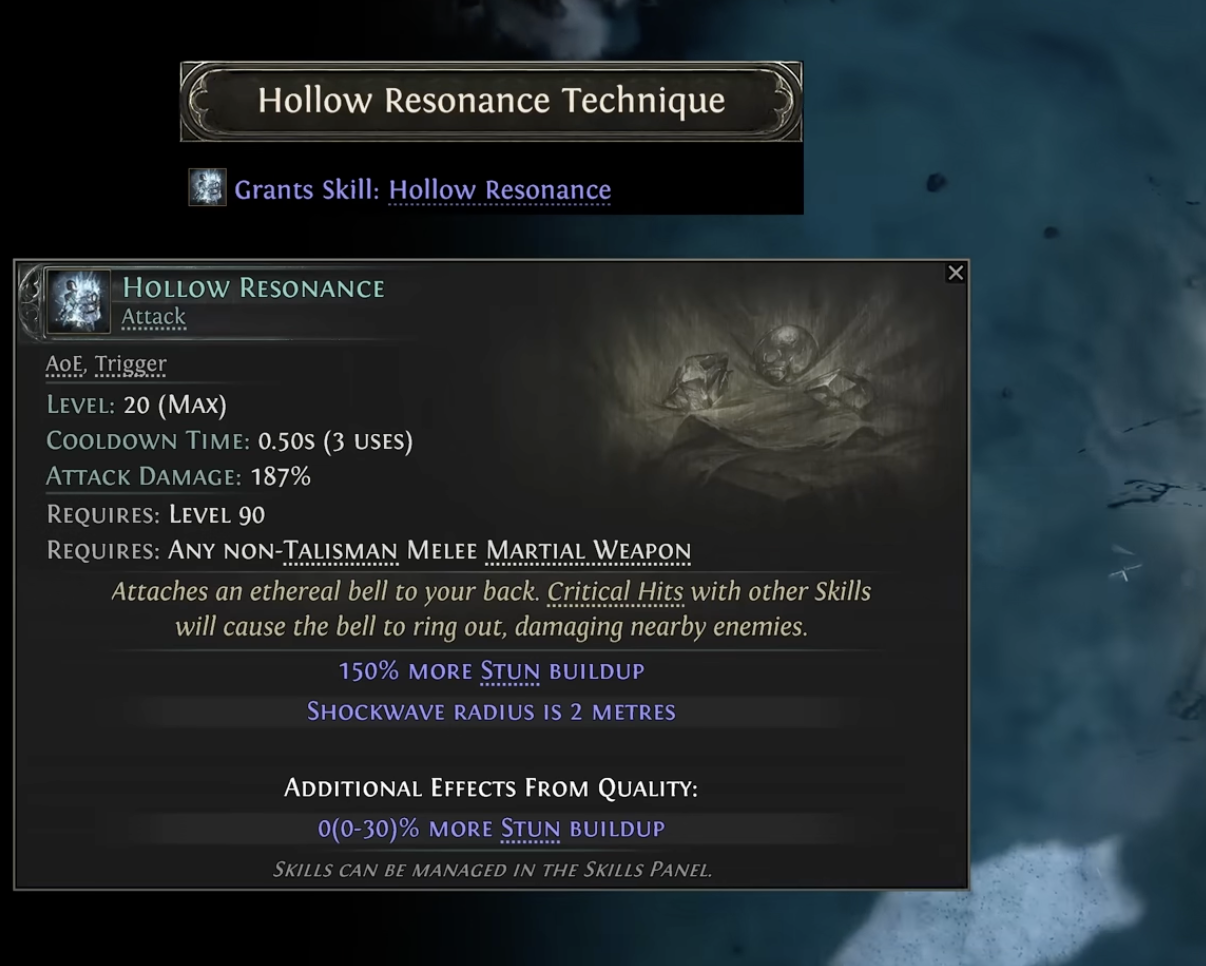
Let's talk about what Hollow Resonance Technique actually does, because it's the glue holding this entire build together. The item grants the Hollow Resonance skill — At Level 20 (Max), AoE Trigger Attack that attaches an ethereal bell to your back. That bell rings out and damages nearby enemies every time you land a Critical Hit with another skill. Cooldown is 0.50s with 3 uses, and base Attack Damage sits at 187%.
Read that again. Three uses. Half-second cooldown. With a 100% crit chance — which this build hits comfortably — that bell is firing constantly, in all directions, without you pressing a single extra button.
The bell also carries 150% more Stun buildup on its hits. Combined with the Stun-stacking nodes you're already taking on the passive tree, this turns every crit into a stun-pressure event. Bosses don't get to breathe. And the shockwave radius is 2 metres — tight, but you're a melee build. You're already in their face.
Why This Works as a League Starter
The weapon requirement — any non-Talisman Melee Martial Weapon — is broad enough that you won't be gated by it during campaign or early maps. Grab a decent quarterstaff or sword, equip the Technique, and the bell is already working for you. No specific uniques required. No elaborate setup.
For new players especially, this is huge. The damage contribution is passive. You focus on landing crits with Whirling Assault or your primary attack, and the bell handles the AoE cleanup automatically. It's a training wheels setup that doesn't feel like training wheels.
The Stun Buildup Number Is Not a Joke
150% more Stun buildup from a passive, always-active source is genuinely oppressive in endgame content. Pair this with Way of the Stonefist gloves scaling your Evasion and Energy Shield per level, and you're stacking stun pressure from multiple angles simultaneously. The bell rings, stun builds, the boss gets locked, Tempest Bell hits for massive damage while they're stunned. That's the loop.
And quality scaling? The tooltip shows 0(0–30)% more Stun buildup from quality. So a 20-quality Hollow Resonance is pushing even harder on the stun axis — which directly feeds into the rest of the Martial Artist toolkit.
Herald of Ice Is the Other Half
The bell handles stun pressure and AoE damage. Herald of Ice handles the clear. Crit a frozen enemy, they shatter, Herald of Ice explodes them. The bell rings on that same crit, adding another wave of AoE. Both effects trigger off the same hit. This is why the community locked in on this combination almost immediately — the synergy isn't theoretical, it's mechanical and direct.
Safe to play. Consistent damage. No mandatory uniques to start. If you're coming back to Monk for 0.5 or picking one up for the first time, Hollow Resonance Technique is the cornerstone you build around — and the rest of the Martial Artist ascendancy slots in cleanly around it.
Câu hỏi thường gặp về Path of Exile 2
- Ngày phát hành Path of Exile 2 là khi nào?
- Path of Exile 2 dự kiến phát hành vào ngày 6/12/2024.
- Path of Exile 2 chơi được trên nền tảng nào?
- Path of Exile 2 hỗ trợ: Xbox Series X|S, PC (Microsoft Windows), PlayStation 5, Mac.
- Path of Exile 2 thuộc thể loại gì?
- Path of Exile 2 thuộc thể loại: Role-playing (RPG), Hack and slash/Beat 'em up, Adventure.
- Có trailer chính thức của Path of Exile 2 không?
- Có. Bạn có thể xem trailer của Path of Exile 2 ngay trên trang này ở phần video.
Khám phá thêm
PoE 2 Patch Notes 0.5.2 Summary: Every Change That Matters for Your Build
Path of Exile 2 patch 0.5.2 dropped on June 12, 2026, and it's one of the more player-friendly mid-league updates GGG has put out. Delirium got easier, Runes of Aldur rewards got better, a wave of monsters got their damage tuned down — and there was a brief, chaotic moment where Gemling Legionnaire nearly got quietly gutted before GGG walked it back. Here's everything that actually matters for your build.
PoE 2 Crafts: The Complete Runeforging & Runic Ward Guide for Patch 0.5

Master PoE crafts in patch 0.5: Complete Runeforging & Runic Ward guide. Learn verisium farming, ezomyte runesmithing, unique upgrades & crafting strategies.
PoE 2 Runic Support Gems: Reddit's Best Builds & Scaling Tips (Patch 0.5)

Patch 0.5 introduced Runic Support Gems that let any class use any skill. Discover Reddit's best builds, Runic Infusion scaling strategies, and how to optimize Ward-based damage for endgame.
Path of Exile Reddit: Runic Skills, Builds & Community Troubleshooting Guide
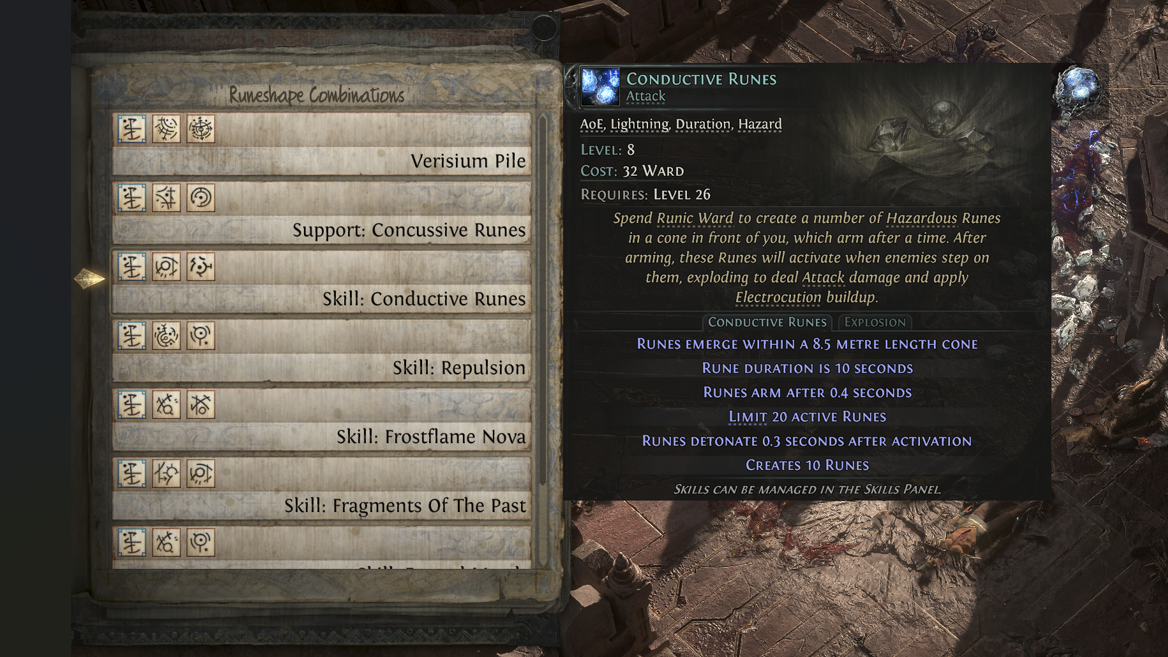
Path of Exile Reddit has dissected the new Runic Skills system since Patch 0.5. This guide pulls together the community's best tips, proven Kalguuran builds, and troubleshooting advice for Ward optimization and Runic skill mechanics.